There is a moment in a new sailing partnership when you stop simply learning how to sail the boat together and start learning how to make the boat fast.
For Hoel and me, San Pedro was that moment.
We became a full-time team in late June, immediately after Hoel graduated from UCLA. Before then, we had been fitting in as many sailing days as we possibly could around his school schedule. Those days were valuable, but they were sporadic. Sometimes we had coaching, sometimes we did not. Often, the skills we were working on were still very fundamental.
Before the World Championship in May, for example, four consecutive training days felt significant. At that stage, we were still working on things as basic as how to tack the boat together or how to accelerate efficiently. We were building the operating system of a new team.
It was enough to get us onto the racecourse.
At Worlds, Kiel Week, and the European Championship, we could race with the international fleet and begin observing, in a much more informed way, where the gaps were between us and the best teams in the world. Those events gave us an enormous amount of information. We could look at the boats around us and start asking better questions. Where were they consistently faster? What were they doing differently? Which differences were equipment-related, which were technique, and which were simply the product of thousands more repetitions together?
But knowing what you need to improve and actually having the time to improve it are very different things.
Our First Real Training Camp
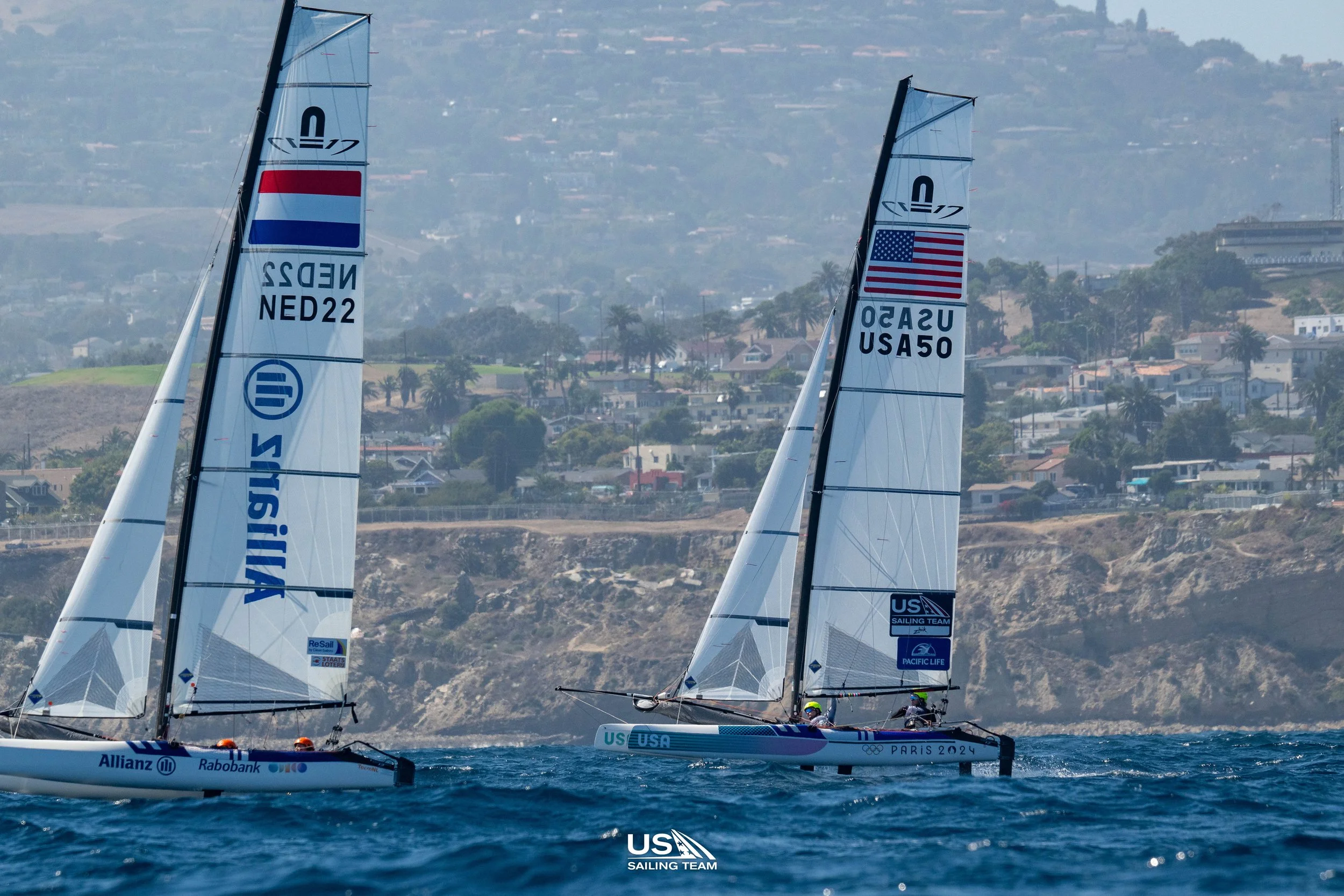
San Pedro was the first time Hoel and I had the opportunity to complete a proper training camp as a full-time team.
We had eight or nine concentrated training days before racing began. For the first time, instead of using our training time to establish basic crew work, we could identify a specific performance problem, work on it deliberately, assess the change, and then go back out and work on it again.
That changed everything.
Our coaches noticed it too. At the end of the block, one of them pointed out how much our pace had changed and how frequently we were arriving at the top of the course immediately behind boats we wanted to be racing against. The gap was still there, but it was small enough to see clearly.
Hoel made a similar observation in our final debrief. There were teams we had barely seen on the racecourse earlier in the season who were suddenly around us over and over again. We were rounding marks near them. We were crossing them. We were starting alongside them and, increasingly, staying in the race with them.
That was probably the most meaningful result of San Pedro for me.
Not because we suddenly believed we had arrived. We haven't. There is an enormous amount of work ahead of us.
It was meaningful because it gave us our first real data point for what happens when this team gets concentrated training time.
Learning to Look at Performance Differently
At this stage of our campaign, our goals are overwhelmingly skills-based.
Of course results matter. We race sailboats, and ultimately the objective is to beat the boats around us. We were proud to be the top U.S. Sailing Team Nacra 17 at San Pedro, and particularly proud of a top-five race finish in an extremely competitive international fleet.
But a finishing position alone tells us surprisingly little about what we need to do tomorrow.
The questions we are asking right now are much more specific.
How does our speed compare at different points of sail? Are we able to hold a lane against the best boats? Are we losing meters because of a decision, or because of pace? How consistently can we reproduce a technique? How does the boat look compared with the boats at the front? Are we creating the same shapes and profiles? Can we execute a skill when we're alone in training, and can we still execute it when there are 20 boats around us and we have to make tactical decisions at the same time?
San Pedro was an exceptionally useful venue for answering those questions because there was very little opportunity to hide.
Our coaches described it as a place where speed differences become extremely obvious. In some venues, good tactics can compensate for a speed deficit. In San Pedro, there were long stretches where the race became much closer to a drag race. If another boat was faster, you found out.
That made the week incredibly productive.
We also began separating two things that can look identical on a results sheet: having a skill and being able to execute that skill under pressure.
There were times in controlled training when we could line up, accelerate, and sail the boat very well. Add a starting sequence, another boat on our hip, tactical decisions, changing conditions, and the quality could deteriorate.
That isn't a mystery or a failure. It is simply the next layer of skill development.
The goal now is repetition.
Good Decisions Come From Good Information
One of my favorite moments from San Pedro actually happened before a race started.
Hoel and I have been trying to build a culture around preparation. We want to be early. We want to be organized. We want our equipment ready. We want enough time on the water to understand what is happening rather than reacting to it once racing begins.
On one race day, we launched early and spent considerably more time than most of the fleet sailing the course and gathering information before the first start.
Our coach pointed it out afterward. His takeaway was simple: good decisions come from good information.
That idea has stuck with me.
Professionalism in an Olympic campaign is often less glamorous than people imagine. It is showing up on time. It is launching early. It is maintaining equipment. It is taking useful notes. It is reviewing video when you're tired. It is asking the right questions. It is being respectful of coaches and training partners. It is eliminating distractions so that the limited hours available for improvement actually produce improvement.
Hoel and I are very different people in some ways, but this is one of the places where I feel incredibly fortunate in the partnership we have found.
We approach learning similarly.
We both want to understand why something is happening. We are comfortable being wrong. We can change our minds when the evidence changes. We can have detailed conversations without taking disagreement personally. Most importantly, when we identify a weakness, neither of us has much interest in protecting our ego from it. We want to work on it.
Our coaches specifically highlighted that growth mindset during the San Pedro block. They saw a team constantly asking how we could get better and encouraged us to combine that analytical approach with an increasing willingness to put ourselves into uncomfortable situations on the racecourse.
That is something we are actively working on.
Coming Back
There is another part of this campaign that is easy for me to normalize because I am living it, but occasionally I remember how unusual the timeline has been.
I competed at the Paris Olympic Games in 2024. I then stepped away from competition in 2025 to have my second child, a baby boy.
I was back in the gym about four weeks after giving birth.
At approximately four months postpartum, I was back on the water and beginning the process of interviewing and sailing with potential partners for the next Olympic campaign.
There was no guarantee that I would find the right person.
A Nacra 17 partnership is an unusual relationship. You spend enormous amounts of time together, often under stress, in an environment where small communication problems become performance problems very quickly. Finding someone with the physical skills to do the job is only one part of it. You also need compatible ambitions, work ethic, communication, temperament, logistics, and approaches to learning.
Finding Hoel has made me feel extraordinarily fortunate.
We are still a very new team. That is not something we are trying to disguise. In many ways, it is what makes this stage so exciting.
We can see how much we don't know yet.
We can also see how quickly we are learning it.
The Most Encouraging Metric
The metric I left San Pedro thinking about most was not our overall finishing position.
It was our rate of conversion.
When we identify a skill gap and get the opportunity to work on it properly, it tends to show up in our sailing very quickly.
Sometimes within days.
That happened repeatedly in San Pedro. We would identify something that was costing us performance, isolate it in training, make changes, and then find ourselves in a meaningfully different position relative to the fleet.
By the end of the block, Hoel described it as finally getting better at things we had been really bad at, while simultaneously discovering the next set of things we could become good at.
That is high-performance sport in a sentence.
You solve one problem well enough to expose the next one.
The encouraging part is that eight or nine days is not very much time.
Until San Pedro, we had never had a proper training camp together as a full-time team. Yet that short block was enough to noticeably change which boats we could race against and how long we could stay with them.
Our next phase looks very different.
We are moving into the off-season with the opportunity for weeks and months of concentrated training, including significant time with excellent coaching. Instead of squeezing sailing days between school commitments, international events, and travel, we can begin building the volume that established teams already have.
One of our coaches made an important point during the event: the teams at the front have spent enormous amounts of time training these specific skills. They have done hours and hours of straight-line work in conditions where we have simply not yet accumulated comparable volume.
There is no shortcut around that.
But for the first time, we now have the opportunity to start accumulating it.
What Comes Next
Our short-term goals are therefore very concrete.
We need more hours together. We need to make our best speed more repeatable. We need to expand the range of conditions in which we can execute our skills consistently. We need to keep developing our ability to sail the boat while simultaneously making good tactical decisions. And we need to continue deliberately putting ourselves into situations that are slightly outside our current comfort zone.
The long-term goal has not changed.
We want to become one of the teams consistently racing at the front of the international Nacra 17 fleet and put ourselves in a position to contend for Olympic selection.
But I don't think about that goal by trying to predict where we should finish at every regatta between now and then.
I think about the trajectory.
A few months ago, we were learning how to tack together.
Then we were learning how to get around an international racecourse together.
Then we were close enough to the fleet to begin accurately identifying the gaps.
Now we are beginning to close them.
San Pedro was the first opportunity we have had to see what happens when we take one of those gaps and give ourselves enough uninterrupted time to attack it properly.
The change after eight or nine days was palpable.
So as we look toward an off-season built around weeks and months of concentrated training, I am less interested in predicting exactly where that will put us than I am in continuing the process that is already working: identify the gap, understand it, train it, measure it, and repeat.
For a team this early in its development, that feels like a very exciting place to be.
The support we have received from the New York Yacht Club High Performance Fund has helped make this kind of training and international campaigning possible. It gives us access not simply to more regattas, but to the training time, coaching, equipment, and international benchmarking that allow those regattas to become genuinely productive development opportunities.
We are extremely grateful for that support.
And after San Pedro, we are also very excited to see what happens when we get to do this over and over again.
Follow the campaign: We are documenting the process, including the training, racing, travel, family life, and realities of building an Olympic campaign, on YouTube at @FoilingMama.